
TE RŌPŪ PIRINOA
THE GROUP

Our research group explores the biology, ecology, evolution and impact of host-parasite interactions in Aotearoa, New Zealand
Based at
Te Tari Mātai Kararehe | Zoology Department
Ōtākou Whakaihu Waka | University of Otago

Funded by
Contact


OUR PROJECTS | NGĀ KAUPAPA
Emerging Aquatic Diseases
Our group is part of a 5-yr MBIE Endeavour Fund Emerging Aquatic Diseases led by Cawthron Institute 2023-2028.
In this space, we support local communities, government and industry partners on issues related to parasites in aquatic ecosystems.


A video that showcases one of our recent kaupapa (projects) within the EAD program about the trematode parasite Copiatestes presence in local waters in Otago, and it's problematic life cycle with potentially dire consequences for our coastal manu (birds).
Made by Global Parasitologist Coalition
Read our paper here: https://doi.org/10.1017/S0031182026101796
Bennett et al. (2026) Temperature driving a mass killer: assessing the risk of trematode outbreaks for New Zealand seabirds. Parasitology
Parasites as Pollution Sponges
We were awarded a 3yr Marsden Fast-Start in 2025 (2026-2029) to explore the role of parasites as pollution sponges.

We all know our oceans are in trouble. Plastic and heavy-metal pollution is harming our marine life, threatening our kaimoana, and damaging our natural environment. This crisis requires immediate action with new perspectives and approaches. What if we looked to an existing naturally occurring solution?
Parasites that live in the gut are often thought of as villains, but they may be ‘hidden protectors” that can help us clean up our oceans thanks to a quirk in how they eat. Unlike us, parasites don’t have a gut, absorbing food directly through their skin via diffusion instead. This means they have the potential to absorb harmful microplastics and toxic heavy metals ingested by their hosts.
This Marsden Fund Fast-Start grant proposes a fresh perspective to the pollution crisis, investigating how intestinal parasites can act as filters that soak up harmful environmental pollutants. We will use seabirds to study how parasites inside their gastrointestinal systems might function as pollution sponges. As humans continue to have a devastating impact on te taiao the environment, this type of research could change the way humans interact with wildlife and think about adaptation and resilience.

Interested in this project/kaupapa?
Contact us for current PhD or MSc opportunities!
Rebuilding productive coastal economies
We are part of a 5-yr MBIE Endeavour Fund Rebuilding Productive Coastal Economies led by University of Otago (2025-2030).
Our contribution will support community aspirations for thriving and sustainable mariculture, with a particular focus on the disease resilience for our taonga kaimoana (treasured seafood).
Interested in this project/kaupapa?
Contact us for current PhD or MSc opportunities!

MSc tauira - Jenna Murrey processing tio (oysters) at Earth Sciences NZ (2026)
Proactive Parasitology
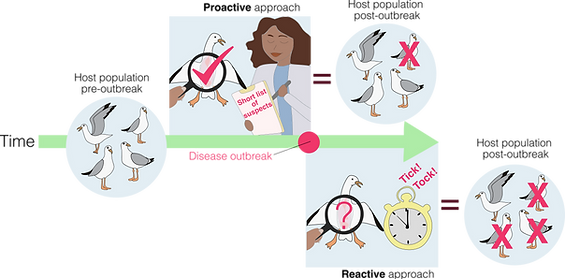
Unlike the reactive approach taken to most disease outbreaks in Aotearoa, we take a proactive approach. We opportunistically collect deceased wildlife and create baseline data on parasite infections. This means that when disease does strike, we already have a shortlist of suspects that could be the cause, and can jump start our response.
We have a bird pipeline with community and agency partners to korokī taku manu i karakaraka ana (give the birds a second life). We create baseline data of what parasites infect our wildlife now, and investigate how these parasite communities vary across species, space, and time. Our group is committed to facilitating the use of materials for cultural use and for other research kaupapa (projects). We've dissected over 1,500 birds and found over 50,000 parasites so far.
Interested in learning more about our pipeline for Aotearoa's birds, or joining one of our dissection wānanga? Get in touch: jerusha.bennett@otago.ac.nz


Te Rōpū Pirinoa - The Parasite Group